Hey
Its been a while and many miles since the last update. the Wiseman pour was a success. It wasn't perfect but iron was poured and art was created above the Arctic Circle.
Our group left for the circle in 2 vehicles. Myself and Shane Morgan in the pickup and D'jean Jawrunner professor at Mesalands Community College and Susan Byrnes and the Wests Laura and Eric in the Tahoe. we left as early as any six people with different dispositions , multiple bags and various molds could manage.
After multiple stops we were actually on the road by 11 am Thursday. we proceeded at a good rate up the parks highway stopping at the Denali viewpoint to get a glimpse of the mountain. We made our way north to the entrance of Denali national park and drove in as far as they allow private vehicles. We saw beavers, caribou and eagles.
We arrived in Fairbanks about 7 pm and stopped for a nice meal at the Chena pump house. after that we gassed up and headed for the Dalton highway. The Highway was in pretty good shape with several sections improved over last year. We drove into the night. Though not dark, as at that latitude night is a concept more than a reality.
When we crossed the Yukon river we decided to stop and sleep a while in the cars, it was about 1;30 am and when we parked I noticed the flat on the Tahoe. Being tired we decided to leave it till morning another concept at this latitude. we slept until 4;oo am got out and changed the tire and continued on our way. We stopped at the arctic circle marker for photos and bathroom breaks. Then we continued on to Cold foot the only truck stop above the arctic circle. After much needed coffee and breakfast we had the tire repaired and pushed the last of the way to Wiseman.
When we arrived Donnie and Butch and Rhonda were already setting up the copula . We unloaded the stuff we brought and helped set up. we spread the molds into pour lines and assembled equipment . Butch burned in the copula for a couple of hours to be sure it was dry and ready for Saturday.
We checked in with our hosts Bernie and Uta of the arctic getaway lodge
and put our stuff in the charming 2 story cabin we had rented. Wiseman was beautiful ,the weather was nice though not warm enough for the non Alaskans.
The pour site was the yard of the Wiseman community center a large log building used for community purposes. We were about 50 yards from the Koyokuk river where we hauled buckets of water from to use in case of fire. Wiseman has about 13 full time residents and about double that in the summer. The residents are living the lifestyle of real alternative energy as the whole village is off the grid and all electricity is generated by each individual home owner by various means including water, solar ,wind, or gas and diesel generators or a combination of all depending on their needs.
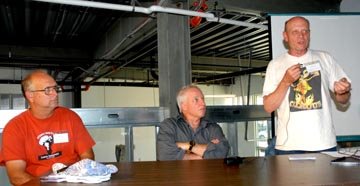
After setting up, we relaxed and visited. The other group were staying at the Boreal lodge the other b&b in town . About midnight, still not dark. Wendy Croskrey and 3 of her students Hannah, Margaret and Tamara arrived from Fairbanks.
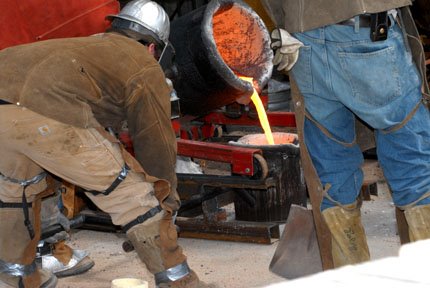
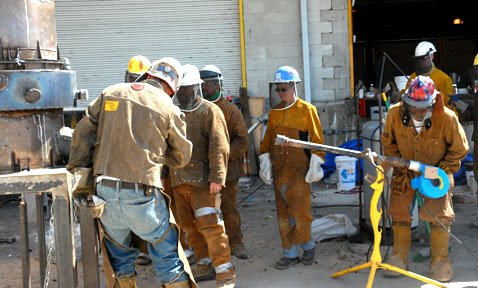
On Saturday we fired the furnace and began the preheat. set out the mold lines and prepared the ladles, after a couple of hours we began charging and in short order had iron at the slag hole. We tapped and poured the first pieces. We had a second successful tap and then the trouble began. On the third tap we couldn't get through to the liquid iron, after several attempts to tap
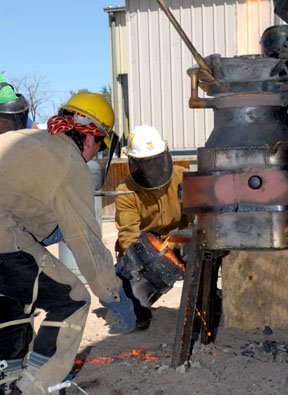
We tipped the furnace on its side and dumped the contents on the ground. We then knocked as much metal and slag out of the furnace as we could, cleared the tap hole set the furnace back upon its stand and refired it with fresh coke,after another preheat we were able to tap a couple more times before we had trouble again. We dumped it out beat on the inside and cleared it again, re heated it and got one tap before it froze up for the third time. We dumped it tried to clear it and finally admitted defeat.
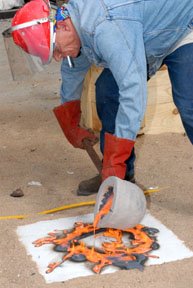
We did manage to get about half the pieces poured including several scratch blocks made by the locals some of which were very nice pieces. The weather for the pour was typical Alaska summer, bright warm sunshine for awhile, cloudy for a while, rain for about 20 minutes and then clearing to partly cloudy . All in the same day. We had about 16 participants about a dozen from outside and the rest from Alaska. The locals came out and watched and participated in making scratch blocks . Bernie and Uta even brought the participants coffee and cookies after the rain storm. We estimated about 50 people at times between participants and spectators. If we include the mosquitoes we had over a million . Yes the mosquitoes were thick.
Like I said , the pour wasn't perfect but we did melt and pour iron in the village of Wiseman.
We had a good time and the locals including some from cold foot and Nenana enjoyed watching and participating. All in All we put it down in our book as a success.
Tuesday, July 1, 2008


Sunday, June 29, 2008
Update to now
Last entry was from
Wiseman is a long established northern most outpost for the gold rush, the place where the first air travel in
We arrived on Thursday evening, the eight of us: Donnie, Kristi, Forrest, Barbra, Joe, Mandy, Rhonda Mc Nally (who met us in
Friday morning we unloaded the trucks and began setting up the furnace, etc. Just at the opportune moment Pat Garley, Shane Morgan (from
Saturday morning we started by unloading molds and charges. We had made the molds in
Next time we went to three full charges of 25 pounds each. And we got lots of very hot metal. Several molds got poured. That seemed to be the answer. BUT, when we tried the same regime the next time we got NOTHING, no metal and the tap hole was frozen.
At that point we had the choice of shutting down or trying to clear the cupolette. We dumped the entire thing, all coke, whatever metal, etc. And started again from new bed coke & back burning to ensure that we had a hot well. Again we got hot metal, more molds got poured; BUT the next time we had a well full of slag and no metal. We decided to call it off and dumped every thing once more. We never did get metal again.
We did cast a plaque, the “cap piece”, the base & one section to the obelisk, plus several of the molds that had come up from Pat’s molding workshop. In retrospect, its obvious that I had made the well too deep and the metal was cooling before the third charge was melted. So much for calculations versus experience. I SHOULD have taken the measurements from the furnace that worked in NYC and raised the slagger and tuyere an inch or so to give us the 50 pounds we needed. But I had recalculated and went with those measurements.
As Pat said, it wasn’t a runaway success, nor was it an unqualified failure. Somewhere in between. The plaque, which poured slightly “short”, but OK, is now installed next to the flag pole at the Wiseman Community center, the base, cap, and section, and other section molds are on their way to Palmer to be finished out and/or poured at the Wasilla pour next Saturday, or, God forbid, at Kenai the Friday after. The entire project will be complete sometime between now and next August.
We cleaned the site on Sunday, after the Saturday pour. Its pretty much the same as when we arrived, except there is a lightly used cupolette sitting next to the 55 gallon, burn barrel and a few chunks of mold waste that will be carved into molds before next year’s Wasilla pour.
But, as far as the residents of Wiseman were concerned, it was a smashing success. When we stopped at the Visitor’s Center and cafe in Cold Foot this Monday morning to get our “certificates” that verify that we have crossed the arctic circle, everyone was happy and still excited. It had been exhilarating for them to have us come and even attempt to pour iron, and the plaque was just gravy after the fact.
And, Oh yeah, I forgot to mention that mid-pour we got about twenty minutes of rain and that the mosquitoes were vicious. Kristin, one of the ladies who invited us to Wiseman, always had a lit mosquito coil in her hand as she walked around. We had to make do with the Off that we brought.
Further Update to Now, Now Having Changed
The current NOW is in Palmer,
The big draw is, of course,
Preparations for the Wasilla Pour are underway. Scott Hamann had delivered the furnace that Pat designed and we burned it in, twice. With a couple of minor modifications it looks ready to run and should tap out between 120-200 pounds, depending.
We have fabricated two ladles, one standard refractory lined and one that D’Jean made with fiber lining, plus we still have two of our smaller fiber ladles as backup, just in case. We still have to make some cupola tools and finish up molds.
Further down the new Now.
The Wasilla pour is history, we haven’t cleaned up the site yet, but its done. Most importantly, it went very well. Lots of good hot iron. The new cupolette tapped 220 pounds, or would have if we’d had a ladle big enough; we had to bott mid-stream and the crew didn’t like a heavy ladle, so we took three taps per set of charges. All the molds poured, only one had any mis-casting, & I suspect that the core was too thick at that point, or it shifted in transit.
The piece for Wiseman is all cast and ready to be finished at leisure. The Wasilla plaque is ready to clean and install. And the
The public information has been spotty and somewhat inaccurate, but great fun. In the local Palmer newspaper D’Jean Jawrunner is the “featured” artist because she is a known quantity here. Pat, Donnie, & I have given her a hard time about it, mostly Pat who is local and can’t get much of a mention in his home town. They have known each other for so long now its difficult to know who did what first, but D'Jean is the "teacher of record". My father always used to say that “a prophet’s mouth is always ‘stopped’ in his own land”, it seems to still be true. We shall see what the Anchorage paper has to say in its Wednesday section.
Pictures and extensive info to follow. Internet access is mostly not easily available, sorry.
Butch
Tuesday, June 17, 2008
Finally to the Interior


I’m not sure exactly what to say about the ferry ride to Haines, it was a boat trip. It was a big boat, but even the biggest isn’t the same as our normal perceptions of space. We normally operate over a much wider area than we think about and its not until you’re in a confined space that you realize just how much area we’re used to occupying.
It was pleasant, the crew seemed efficient, & the cabin was small for the four of us: myself, Forrest, Donnie & his daughter Kristi. I spent much time in the lounge areas or on deck, either reading or watching the mountains go by. I’ve never been to
The ship had selective WIFI connectivity, at its discretion, not ours; and when we were at or around a city some had cell phone connectivity, but not me.
What the isolation did for me was to make me wonder just why I prefer to pour iron. Why was I spending this much time, effort, and money to go to an end of the earth to pour iron? I’ve been on “why iron” panels at conferences, but I’ve never felt that I succinctly stated its allure. Physically its heavy, at pouring temperatures its dangerously hot, it has more intrinsic energy, when spilled it “bounces”, and at the proper temperature it runs into thin sections better than any other metal. It’s a common metal, most of the earth’s surface contains at least some iron, so its fitting for the proletariat in me that works hard at difficult tasks for not much reward. It’s a very “moral” metal, almost Puritanical in its difficultly and demand, but more positive in its feedback in the form of an object than any religion can promise. And at its most basic, its beautiful; regardless of what stage of the object making process you look at it. Fresh from the mold its black and gritty, cleaned and blasted its pristine yet soft appearing, and once it begins the patina process of corrosion it reveals nuances of color. There’s a reason why iron is the most versatile glaze colorant for potters, it runs the gamut from reds, oranges, and yellows to the celadon blues or greens to browns, a “temoku purple” and deep and mysterious black. Truly phenomenal and it lasts. We stopped at a museum with objects from the “gold rush” days and there were objects that, while not in their original usable condition, gave mute testimony to some long forgotten person’s efforts.
So I gazed at my navel when I wasn’t looking at scenery.
Now we’re in
The scenery through
The major impediment to enjoyment was the weather. It was cold and rainy most of the trip, it still is as I type this. Hopefully we will get at least dryer conditions when we get to Wiseman.
And this is probably a good time to introduce our “shadow group” from
Another welcome addition will be D’Jean Jawrunner. I was so pleased when I read Pat’s post saying that she had arrived. It was at her place in
And the link is current at IRONPOUR.COM, thank you Michael.
If dryer lint is a “feminist material”, what is belly-button lint?
Butch
they're here
Hey
Well we have some new arrivals in Alaska. Donnie keen and Butch Jack and company have arrived in Haines and are making thier way to Wiseman.
Tonight I picked up 4 participants at the Anchorage airport. Laura and Eric West are here and D'jean Jawrunner and Susan Byrnes also arrived . They managed to arrive within the same hour on 3 different flights by 3 different carriers.
We will be spending the next couple of days making sand molds and preparing stuff for the trip to Wiseman trip. We plan to leave early Thursday and head for Wiseman.
Speaking of new arrivals Scott Hamann of Kenai came up to Palmer this last saturday and dropped off the new cupolette. The Metal Magic Melter Is a beauty and hopefully will live up to her name. we will be doing a trial run next week to make sure we are ready for the Wasilla and Kenai pours.
Thats all for now.
Pat
Sunday, June 15, 2008
The last day ashore & aboard the Good ship Columbia

The last day ashore & aboard the Good ship
The last day before boarding the ferry was spent getting some warmer clothes at REI and a trip to the campus of

We went to check in for the ferry loading and were put in line with the other vehicles that were bound for Haines, the last stop of the voyage. Because we were going to the end of the line, we were among the last to load, but only after the home-land security dog decided we were OK.

It has occurred to me that many folks who would be likely to read this, think of a ferry in the same size, scale, & configuration as the ones at Boliver peninsula; the
As for the passage itself, the scenery is very green & grey. The sea reflects the grey of the overcast sky and the mountains on both sides of the channels are vertical slabs of evergreen trees. The mountains aren’t that tall compared to the Rockies, they stick straight up out of the water for as much as 3000 feet, but there is snow on the wind scoured tops and the grey of the sky blends with the snow, so the only way to judge the height is to follow the trajectory of the trees going up the edges. The cloud ceiling is low enough that some of the mountain tops are obscured. We have traversed some open water; there were whales and dolphins in those areas; I have to admit I didn’t see them, but there are crowds of people at the front viewing areas who did. We get to
And, there are some who don't know Forrest Goodhue of Beaumont, TX. He is the "Photographer of all things iron" & has been for the past ten years and it is our good fortune to have him along on this journey of iron.
Friday, June 13, 2008
time is flying
Hey
On the Alaska end of things its going to get hectic soon with the arrival of the road travelers and others who are flying in. four people are arriving Monday into Anchorage where I'll pick them up.
Our furnace for the Wasilla and Kenai pours is built. The refractory cast. The blower is being mounted and accessories are being fabricated, Ladles, skimmers etc.
We will be making sand molds at my studio in Palmer on Tuesday and Wednesday and are planning to leave for Wiseman on Thursday morning. The weather in Alaska has been on the cool side with highs in the upper 50s and lows in the 40s. but I hope for a little warmer weather next week.
In a little research about casting in Alaska I have found references to Iron foundries set up first by the Russians in what is now Sitka. They used charcoal to cast iron fittings for the ships they built to service the fur trade. Later references to a Iron foundry in Juneau which used coal to make and repair equipment for the gold mines in the area. Other references and photos around 1920 talk about the coking of coal for an iron foundry in Anchorage operated by the railroad.
With Alaska's long history of major mining operations even above the Arctic Circle such as Nome.
I would hesitate to say this will be the first Iron pour above the Arctic circle. Though it may be.
It will definitely be the first for the purpose of creating art work.
well back to work.
Pat
Thursday, June 12, 2008
Just about to ferry to Alaska
Tomorrow we board the ferry to Haines, Alaska. Its more of an adventure than the pour, since I'm a native of Kansas and we didn't have such large bodies of water. And its the closest thing to a vacation on the trip because there's nothing that we can or have to do. I do have a new phone, but it may or may not work, partially their fault, partially where we're going. And I no longer have anyone's phone numbers, so I can't call anyone anyway. It is passing strange how dependent we become on these technological props, I avoided it as long as I could, but even I succumbed to the convenience.
I suppose to be "accurate" about the whole event we should somehow use a natural draft system and eschew the generator that we brought to power the blowers; maybe a bellows of some description. Technology doesn't so much change, as get more productive through an automation and development of sorts. We won't sit around in a circle puffing into the furnace because the electric blowers do it for us. But otherwise the processes are basically the same as two millenniums past; a worker from the Darby furnace in Ironbridge, England would recognize everything we have to make our job easier than was his. He might not prefer it to what he was used to, but it wouldn't be that foreign to him.
Oh well, its late; it brings on idle speculation.
Always know where the lifeboats launch,
Butch
Subscribe to:
Posts (Atom)